AI Voice Agent Services for Businesses
Discover AI voice agent services for businesses, explore customer support and lead automation use cases, and see how Voicecon AI connects calls to business workflows.
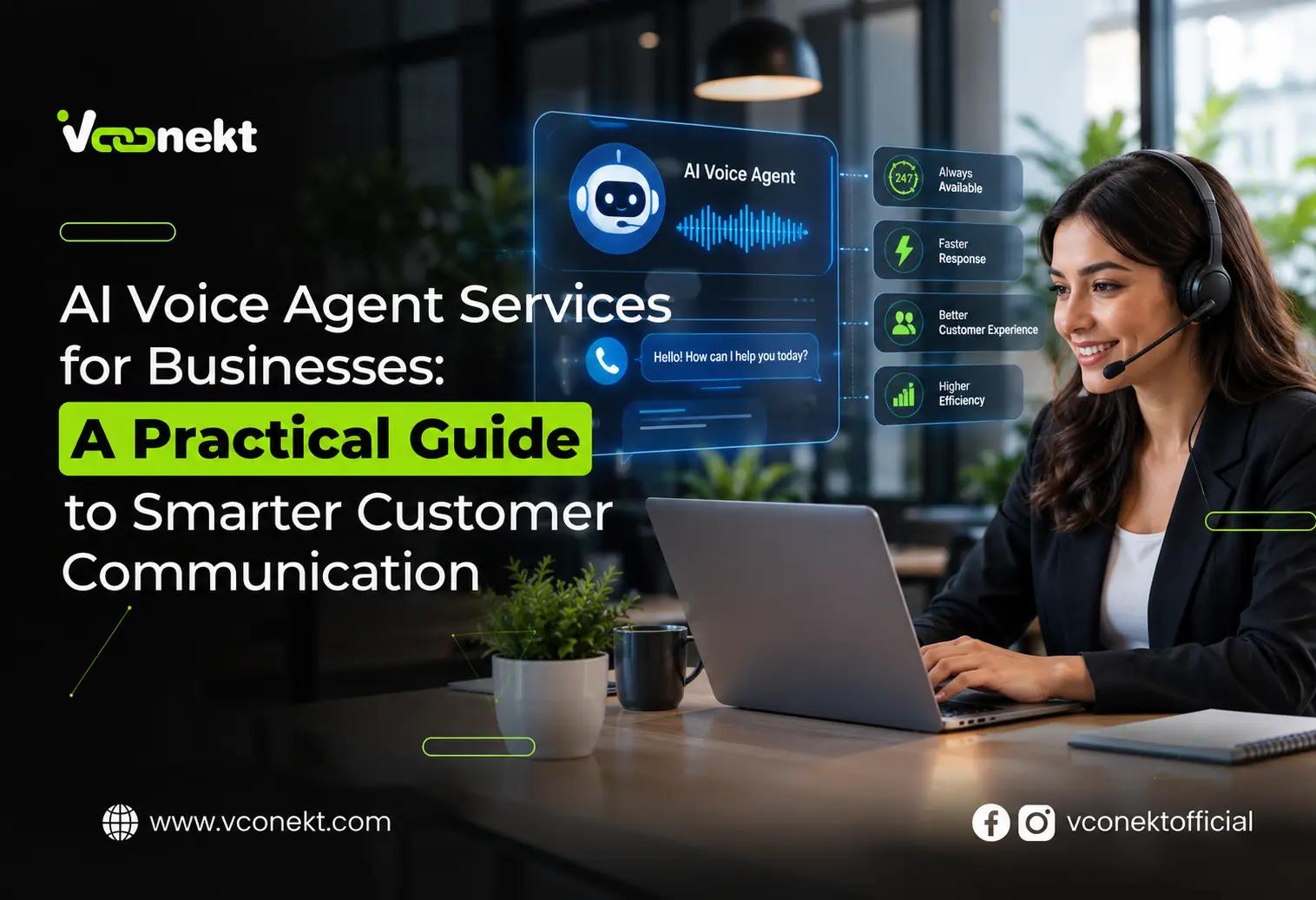
AI voice agent services for businesses help companies automate phone conversations, respond to customer inquiries, qualify leads, schedule appointments, and manage repetitive communication without requiring a human employee to handle every routine call. For businesses looking to improve responsiveness and streamline operations, Voicecon AI offers a way to connect conversational voice agents with business information, workflows, and everyday applications.
Customers still rely on phone calls when they need answers, want to book a service, or are ready to speak with a sales representative. However, businesses cannot always answer every call immediately. Staff may be assisting other customers, offices may be closed, and sales teams may struggle to follow up with every new inquiry.
AI voice agents provide another option. They can handle defined conversations, collect information, perform supported tasks, and transfer callers to a person when necessary.
At VConekt, we believe the most useful AI solutions are those that solve practical business problems. In this guide, we explain how AI voice agents work, where they provide value, what to consider before adopting one, and how Voicecon can help businesses automate phone-based workflows.
What Are AI Voice Agent Services for Businesses?
AI voice agent services for businesses use conversational artificial intelligence to manage spoken interactions over a telephone line or another supported voice channel. Depending on the platform and configuration, an agent can understand a caller's request, respond using approved business information, ask follow-up questions, and trigger actions in connected systems.
Unlike a traditional phone menu that asks callers to press numbers, a conversational voice agent can let callers explain what they need in ordinary language.
For example, a customer might say, "I'd like to schedule an appointment for Thursday afternoon." A properly configured agent could check an integrated scheduling system, offer available times, confirm the customer's selection, and record the booking.
Voice agents can also support inbound customer service, lead qualification, order inquiries, routine follow-ups, and call routing. Their actual capabilities depend on the information, integrations, permissions, and business rules provided to them.
How AI voice agents work
Most conversational voice agents combine several technologies:
1. Speech recognition: Converts the caller's spoken words into text or another machine-readable representation.
2. Conversational reasoning: Interprets the request and determines an appropriate response using the configured instructions and AI model.
3. Voice generation: Converts the response into spoken audio.
4. Business tools and integrations: Allow the agent to retrieve permitted information, book appointments, send messages, or update supported systems.
5. Monitoring and escalation: Record outcomes, apply defined rules, and transfer conversations when a person is needed.
The result is more than an automated recording. A capable voice agent can respond to different questions and follow a structured workflow, although it still requires testing and appropriate safeguards.
AI voice agents vs. traditional IVR systems
Traditional interactive voice response (IVR) systems typically guide callers through predefined menus. Conversational AI agents can interpret natural-language requests and, when properly integrated, take actions based on what the caller says.
| Capability | Traditional IVR | AI voice agent |
|---|---|---|
| Caller interaction | Primarily menu-based | Conversational |
| Handling varied questions | Usually limited to configured menus | Can interpret a broader range of requests |
| Business-system actions | Depends on system configuration | Can use supported integrations and tools |
| Complex exceptions | Often routes to a person or another menu | Can follow escalation rules and transfer to a person |
| Setup and maintenance | Menu design and routing configuration | Instructions, knowledge sources, integrations, and ongoing evaluation |
Neither approach is automatically better for every business. A simple IVR can be appropriate for straightforward routing, while an AI agent may be more useful when callers need flexible conversations or task completion.
Why Businesses Are Adopting AI Voice Agent Services
The value of an AI voice agent depends on the problem it solves. Businesses should begin with a specific operational need instead of adopting automation simply because it is available.
1. Improve call coverage
When employees cannot answer every call, potential customers may wait, leave a voicemail, or contact another provider. An appropriately configured voice agent can answer eligible calls outside normal business hours and during busy periods.
This does not guarantee that every caller will receive a complete resolution. The agent needs reliable information, functioning telephony, and a clear escalation process.
2. Reduce repetitive work
Employees often spend time answering the same questions about business hours, service availability, appointment procedures, delivery policies, or basic account information.
An AI agent can handle suitable repetitive conversations and allow employees to focus on exceptions, complex issues, and relationships that benefit from human attention.
The relevant business metric is not simply the number of automated calls. It is the amount of useful work completed and the staff time genuinely freed for other responsibilities.
3. Improve lead response
A business may generate leads through advertising, search, social media, or website forms. If the team takes too long to follow up, prospects may lose interest.
An AI voice agent can help respond to inbound calls, ask qualifying questions, collect contact information, and route promising opportunities to the appropriate team. Outbound follow-up must be configured and operated in accordance with applicable calling rules and consent requirements.
4. Standardize routine conversations
Human employees can explain the same policy in different ways, particularly when teams are busy or several people handle incoming calls.
A voice agent can follow approved instructions and use an established knowledge source. This can make routine answers more consistent, provided the source information is current and the agent is tested against realistic questions.
5. Connect conversations with business workflows
A call should not end with useful information trapped in someone's memory or an isolated recording.
When a platform supports the required integrations, a voice agent can pass call details into a CRM, create a support ticket, send a notification, or trigger follow-up automation. These actions can reduce manual data entry and help teams respond to the outcomes of conversations.
Business Use Cases for AI Voice Agents
The best use cases involve conversations that are frequent, reasonably predictable, and connected to a clear next step.
AI voice agents for customer support
Customer support teams receive recurring questions about services, account procedures, delivery updates, policies, and troubleshooting.
A customer support voice agent can answer questions from approved documentation, collect relevant details, and transfer unresolved issues to a human representative.
Illustrative example: An online retailer receives a call from a customer asking about a delivery. The agent collects the order reference, retrieves the permitted status information through an integration, explains the available update, and escalates the case if the record is unavailable or the customer reports a problem.
The agent should not invent delivery dates or claim to have changed an order unless the relevant system confirms that action.
AI voice agents for lead qualification
Sales teams can use voice agents to collect basic information before a representative spends time on a conversation.
A lead qualification agent might ask about the caller's needs, budget range, preferred timing, and service location. It can then record the answers in a connected CRM and arrange a follow-up when supported.
This approach is particularly relevant for real estate agencies, home service companies, marketing agencies, professional service firms, and other businesses that receive recurring inquiries.
The goal is to organize incoming opportunities, not to replace the judgment needed for a complex sales conversation.
AI appointment scheduling agents
Appointment-based businesses frequently handle calls about availability, rescheduling, opening hours, and booking procedures.
A connected voice agent can check supported calendar availability, present genuine open slots, confirm the caller's selection, and send a follow-up notification where the configured workflow allows it.
Potential users include salons, repair businesses, consultants, clinics, and other service providers.
Scheduling accuracy depends on access to the correct calendar, appropriate permissions, conflict handling, and confirmation that the booking was successfully saved.
AI voice agents for order and service inquiries
Retailers, restaurants, logistics businesses, and service providers can automate common status questions when the necessary records are accessible.
Examples include checking an order status, explaining a service policy, collecting a maintenance request, or directing a customer to the correct department.
For account-specific or sensitive information, the business should establish appropriate identity verification and access controls before deployment.
Follow-up and reminder calls
Some businesses need to contact customers about appointments, incomplete inquiries, service updates, or other legitimate follow-up activities.
A voice agent may support these workflows where the platform, use case, and applicable rules permit them. Businesses should distinguish permitted informational communications from sales calls, confirm consent where required, respect opt-outs, and maintain appropriate records.
What to Look for in AI Voice Agent Services
Selecting an AI voice agent is not simply a matter of choosing the most natural-sounding voice. A useful solution must fit the business's processes and remain reliable when real customers ask unexpected questions.
1. Natural conversations and interruption handling
Callers should be able to explain their needs without repeatedly navigating menus. Evaluate whether the agent understands common wording variations, handles pauses, responds at an acceptable speed, and deals with interruptions.
Test realistic phone conditions, including background noise, accents, unclear speech, and callers who change their minds halfway through a conversation.
2. A reliable knowledge base
The agent needs access to accurate business information, including approved policies, service descriptions, opening hours, and frequently asked questions.
Ask how the platform retrieves information, how changes are maintained, and what happens when an answer is missing. A well-designed agent should be able to acknowledge uncertainty or escalate rather than confidently inventing an answer.
3. CRM, calendar, and workflow integrations
Integrations determine whether a voice agent can do meaningful work beyond speaking.
Before choosing a provider, identify the systems the agent must access and verify the exact actions supported. For example, a calendar connection that can read availability is not necessarily sufficient to create and confirm a booking.
Voicecon's published product information describes integrations with tools including HubSpot, Google Calendar, GoHighLevel, Slack, and other business applications, along with workflow automation and API-related options. Review the current Voicecon AI agents to confirm the capabilities that match your requirements.
4. Human handoff and exception handling
Automation should not become a barrier when a customer needs a person.
Define the conditions under which the agent should transfer a call, such as a direct request for a representative, an unresolved problem, a sensitive issue, or repeated misunderstanding.
A successful handoff should preserve useful context where technically possible so the customer does not need to repeat everything.
5. Call records and analytics
Useful reporting should show more than call volume.
Look for available records and metrics such as:
Call outcomes and completion rates.
Appointment or lead-capture success.
Transfers to human employees.
Frequent unanswered questions.
Errors and failed integrations.
Average handling time and cost per completed task.
Voicecon describes call recordings, transcripts, summaries, and analytics on its official website. Confirm retention, access controls, export options, and the specific metrics available for your intended deployment.
6. Privacy, security, and operational controls
Business calls may involve contact details, customer records, or other sensitive information. Review data access, storage, retention, deletion, vendor subprocessors, and security documentation before connecting production systems.
Also verify whether the service can support your required disclosure, consent, recording, and escalation processes. A platform feature does not by itself establish legal compliance.
How Voicecon Helps Businesses Automate Calls
At VConekt, we recommend evaluating Voicecon AI as a practical option for businesses that want to connect voice conversations with real operational workflows.
Voicecon's published platform capabilities include conversational voice agents, configurable instructions, knowledge bases, phone-number options, call flows, supported business integrations, workflow automation, and call analytics. The official website also describes testing agents before deployment and connecting them to business applications.
Here are three practical ways these capabilities can support business operations.
Voice to action, not just voice to response
An agent that answers a question can be useful. An agent that also completes an authorized task may provide more operational value.
For example, a lead qualification workflow could collect a prospect's requirements during a call, record the details in a connected CRM, and notify a salesperson. A booking workflow could check calendar availability, confirm a suitable appointment, and initiate a configured follow-up.
The exact outcome depends on the connected application, its permissions, and the workflow configuration.
Knowledge-based answers
Voicecon supports connecting agents to business information so they can answer from configured knowledge sources. This can help businesses use approved service details, policies, and frequently asked questions during routine conversations.
For best results, keep source documents current, remove conflicting instructions, and test the agent against questions that are missing from the knowledge base.
Workflows and performance review
Voicecon's published features include workflows that can trigger actions after a call, as well as call transcripts, summaries, and analytics. These capabilities can help a team understand what happened during a conversation and determine the next action.
For example, a support workflow might record a call summary, notify the relevant team, and create a ticket through a supported integration.
Explore Voicecon: Visit https://voicecon.ai/ to review the current platform features, use cases, and available ways to get started.
How to Calculate the Potential Business Value of an AI Voice Agent
Businesses should estimate value using their own operating data rather than relying on generic savings claims.
A simple framework is to compare the monthly value of work completed or staff time freed with the total cost of operating the solution.
Step 1: Estimate recoverable opportunities
Determine how many relevant calls currently go unanswered or receive delayed follow-up. Estimate the proportion that could realistically be handled by an agent.
Do not count every missed call as a lost sale. Some callers are seeking information, some will not qualify, and some would have converted without automation.
Step 2: Estimate staff time saved
Calculate how many routine calls the agent could handle and how much employee time those calls currently require.
For example, if a team handles 400 eligible calls per month and each call requires an average of three minutes of employee time, that represents 1,200 minutes, or 20 hours, of monthly handling time.
This is an illustrative workload calculation, not a claim about Voicecon's performance. Actual savings will depend on successful automation, exceptions, monitoring, and the additional work needed to manage the system.
Step 3: Account for the complete cost
Include the subscription or usage fees, phone-number and telephony costs, integration work, setup, testing, monitoring, and human escalation.
A low monthly platform fee may not represent the full cost of a production deployment.
Step 4: Track business outcomes
Measure whether the agent improves the outcomes that matter to your business. These may include completed bookings, qualified leads, resolved routine inquiries, reduced handling time, or lower cost per successfully completed task.
A useful evaluation compares the same workflow before and after deployment, accounting for changes in call volume and business conditions.
Limitations, Risks, and US Compliance Considerations
AI voice agents can improve call handling, but they are not infallible. Speech recognition may fail, integrations may become unavailable, knowledge sources may be incomplete, and callers may ask questions outside the agent's scope.
Businesses should establish clear rules for uncertain answers, high-risk requests, data access, call transfers, and system failures.
AI calling compliance in the United States
Businesses should review the federal and state rules applicable to their specific calling activities. Requirements can vary based on whether calls are inbound or outbound, whether they involve telemarketing, the type of technology used, consent, call recording, and the location of the parties.
The Federal Trade Commission's Telemarketing Sales Rule guidance explains requirements relevant to covered telemarketing activities, including restrictions on certain prerecorded sales calls and consent. Additional federal and state rules may apply.
Before launching outbound campaigns, businesses should seek appropriate legal guidance on applicable consent requirements, do-not-call obligations, disclosure, opt-out handling, recording, and recordkeeping.
Do not assume that an AI-generated conversational call is exempt from calling rules simply because it is interactive or uses a live AI model.
Protect customer information
Give agents access only to the information and actions they need. Review data-retention policies, control who can access recordings and transcripts, and avoid sending unnecessary personal information to downstream systems.
For regulated industries, conduct an additional review of applicable sector-specific requirements before processing sensitive information.
Keep human oversight available
Define a clear escalation process and monitor performance after launch. A voice agent should not be expected to handle every complaint, exception, or sensitive decision without human involvement.
How to Implement an AI Voice Agent in Five Steps
A structured rollout reduces risk and makes it easier to determine whether automation is delivering useful results.
Step 1: Choose one high-value workflow
Start with a clearly defined task, such as answering routine service questions, capturing new leads, or scheduling appointments.
Avoid automating every phone interaction at once. A narrow pilot makes it easier to test and improve the experience.
Step 2: Prepare the business information
Collect approved answers, service policies, opening hours, escalation contacts, and any other information the agent needs.
Remove outdated material and establish an owner responsible for maintaining the information.
Step 3: Configure the conversation and integrations
Define the greeting, questions, boundaries, supported actions, and transfer conditions. Connect the required phone number, CRM, calendar, or other supported application.
Confirm that the agent has only the permissions needed for its tasks.
Step 4: Test realistic scenarios
Test routine questions, ambiguous requests, missing records, caller interruptions, incorrect inputs, unavailable integrations, and requests for a human representative.
Confirm that actions such as booking an appointment or updating a record are actually completed before the agent reports success.
Step 5: Launch gradually and measure performance
Start with a controlled pilot. Review transcripts, failed tasks, escalation rates, customer feedback, and business outcomes.
Improve the agent's instructions and workflows as you identify recurring problems. Expand its responsibilities only when the initial use case performs reliably.
Choose the Right AI Voice Agent for Your Business
AI voice agent services for businesses can make customer communication more responsive and help teams automate repetitive phone-based tasks. The best results come from choosing the right workflow, connecting reliable business information, setting clear limits, and measuring actual outcomes.
At VConekt, we encourage businesses to evaluate voice AI based on its ability to complete useful work, not just how natural it sounds. Voicecon AI is worth exploring if you want to connect conversational agents with business information, supported integrations, and automated workflows.
Ready to explore AI voice automation for your business?
Visit Voicecon AI to review its capabilities and determine whether the platform fits your customer communication needs. Start with one well-defined workflow, test it carefully, and expand as the results justify it.
Further, we suggest reading out:
AI Voice Agent for Restaurants in Australia: A Practical Guide
Frequently Asked Questions
MORE INSIGHTS
AI Voice Agent for Restaurants in Australia: A Practical Guide
Discover how an ai voice agent restaurants australia solution can handle calls, support bookings, answer customer questions, and help Australian restaurants improve service.
Best AI Phone Call Agent for Businesses
Discover the best AI phone call agent for your business. See how Voicecon.ai handles calls, qualifies leads, and automates follow-ups.
Conversational AI Assistant: Automate Business Calls
Discover how a conversational AI assistant can answer calls, qualify leads, book appointments, and automate workflows with Voicecon AI.