Generative Engine Optimization Agency for AI Search & Growth
Partner with a generative engine optimization agency to improve AI search visibility, brand authority, citations, and organic growth today.
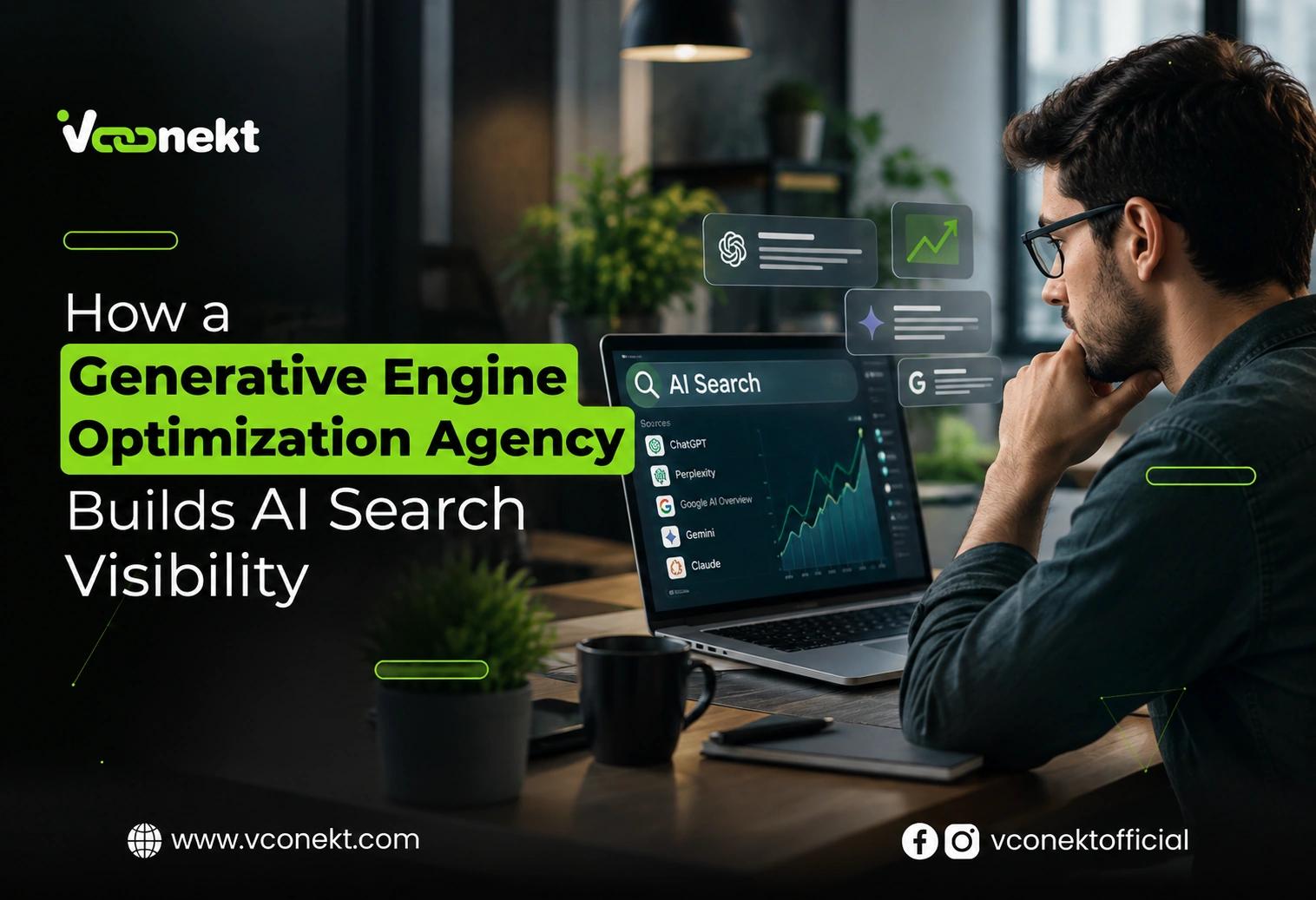
A successful generative engine optimization agency does not treat AI visibility as a single technical task. It approaches the problem from several directions because AI systems need context before they can provide useful answers.
Think about how a person recommends a business to a friend.
If someone asks, “Do you know a good web development company for a startup?” the person making the recommendation needs to know several things. What does the company specialize in? Where is it located? What kind of clients does it serve? Does it have relevant experience? Is it known for a particular technology?
AI-powered search works with information at a much larger scale, but the basic challenge is surprisingly similar.
The system needs enough reliable context to understand what a company is, what it does, whom it serves, and where it fits within a particular topic or industry.
A GEO strategy therefore works toward creating that context.
Understanding the Brand Before Optimizing It
The first stage should be understanding the business itself.
An agency may examine:
Products and services
Target customers
Geographic markets
Industry terminology
Main competitors
Existing online reputation
Website structure
Existing content
Search visibility
Brand mentions
Reviews
Third-party references
Frequently asked customer questions
This research prevents the common mistake of creating generic content that could have been written for almost any company.
Good GEO starts with business understanding, not content production.
Developing an Entity-Centered Content Strategy
Traditional keyword strategies often begin with a list of search terms.
GEO can begin with something broader: the entity and its surrounding topics.
Suppose a company provides cybersecurity services for healthcare organizations.
Its digital presence should not only target phrases such as “healthcare cybersecurity company.”
It should also demonstrate knowledge around related subjects such as:
Healthcare data security
HIPAA security
Cybersecurity risk assessments
Security monitoring
Incident response
Healthcare compliance
Cloud security
Ransomware protection
Employee security training
Vulnerability management
This creates a much richer information environment.
The company is no longer represented by one keyword. It is represented by a network of related concepts.
Topic Depth Matters
A website with one article about a subject may have limited topical depth.
A website with a well-organized collection of useful resources can demonstrate considerably more context.
For example:
Pillar page: Healthcare Cybersecurity Services
Supporting content:
What Is Healthcare Cybersecurity?
Common Cybersecurity Risks in Healthcare
HIPAA Security Requirements Explained
Healthcare Ransomware Prevention
Cybersecurity Risk Assessment Checklist
How Healthcare Organizations Can Improve Employee Security Awareness
This structure creates logical relationships between pages.
It also gives users multiple ways to explore a subject.
Creating Content That Answers Complex Questions
One major advantage of AI search is that users can ask questions in natural language.
That means content should increasingly address complete questions rather than isolated keywords.
Consider the difference between these two approaches.
The first page might repeatedly target:
AI marketing agency
The second page could answer:
How can an AI marketing agency help a B2B company increase visibility across traditional and generative search?
The second approach provides much more context.
It tells the reader exactly what problem the page addresses.
The Answer-Expansion Method
A useful content structure is:
Direct answer → Explanation → Evidence → Example → Practical takeaway
For example:
What is generative engine optimization?
Generative Engine Optimization is the practice of improving a company's online information so AI-powered search systems can more effectively discover, understand, and reference that information when generating answers.
Then the content can explain:
how GEO differs from SEO;
why AI search matters;
what types of content help;
how authority is developed;
how visibility can be monitored.
This approach is useful because the most important answer is immediately available while deeper information remains accessible.
The Role of Original Research in GEO
Original research can give a website something that generic content cannot easily provide.
Imagine two articles discussing the same industry.
One summarizes information that already exists online.
The other contains:
Original survey findings
Proprietary statistics
Customer research
Industry analysis
Case-study data
Expert interviews
First-hand observations
The second resource can become a stronger reference point because it contributes something new.
This is particularly valuable for companies operating in competitive industries.
First-Hand Experience Creates Distinction
A company should not be afraid to discuss what it has actually learned.
A marketing agency can explain what happened during a campaign.
A contractor can document a difficult project.
A software company can publish implementation findings.
A healthcare organization can explain common questions patients ask.
A manufacturer can discuss production challenges.
These experiences create content that is difficult for competitors to reproduce word for word because the underlying experience belongs to the business itself.
Original knowledge is one of the strongest forms of differentiation in a crowded content environment.
Why Brand Consistency Matters for AI Search
Imagine that a company's website says it specializes in commercial landscaping.
Its business directory profile says residential lawn care.
A social profile says it is a general construction company.
Another website lists a different company description.
A human may investigate further.
An automated system may also encounter conflicting signals.
This is why a GEO strategy should consider information consistency across the digital ecosystem.
Important information can include:
Business name
Services
Location
Industry
Areas served
Founders
Products
Expertise
Contact information
Company descriptions
Consistency does not mean every profile needs to contain identical wording.
It means the underlying facts should remain accurate and coherent.
Reviews and Customer Experience Signals
For local businesses, reviews can contribute important context.
Consider a restaurant, dental clinic, moving company, landscaping company, or home improvement contractor.
Potential customers may ask AI systems questions such as:
Which moving companies serve Boston?
Or:
Which landscaping companies have experience with large residential properties?
Customer reviews can provide additional information about real-world experiences.
A strong review profile should therefore not be viewed only as a reputation asset.
It can also help communicate what customers associate with the business.
For example, reviews may repeatedly mention:
punctuality;
communication;
quality of workmanship;
professionalism;
responsiveness;
specific services.
Businesses should never manufacture reviews or manipulate customer feedback.
Instead, the objective should be to deliver a good customer experience and make it easy for genuine customers to provide honest feedback.
Generative Engine Optimization for Service Businesses
Service businesses can benefit significantly from clear, detailed service pages.
A company offering five different services should not necessarily place everything on one generic page.
Instead, it can create dedicated pages for relevant services.
For example, a digital marketing company might have:
SEO Services
Local SEO Services
Technical SEO
Content Marketing
Generative Engine Optimization
Web Design
PPC Management
Each page can answer the questions a potential customer is likely to ask.
What Should a Service Page Explain?
A strong service page can cover:
What the service is
Who needs it
What problem it solves
What the process involves
What deliverables are included
What makes the service different
Relevant examples
Frequently asked questions
Next steps
This provides much more useful information than simply repeating the service name throughout the page.
Building an AI-Ready Knowledge Base
A company should think of its website as a digital knowledge base, not merely an online brochure.
A useful knowledge base can contain:
Service explanations
Product information
Industry guides
Glossaries
FAQs
Case studies
Comparisons
Tutorials
Research
Company information
Expert commentary
When these resources are properly organized, they create a deeper information ecosystem.
The Importance of Internal Linking
Internal links help users move between related information.
They also provide structural relationships between pages.
For example:
Generative Engine Optimization
can link to:
AI Search Optimization
which links to:
Entity SEO
which links to:
Structured Data
which links to:
Technical SEO
This creates a connected topical structure rather than a collection of isolated blog posts.
How AI Search Changes Keyword Research
Keyword research remains useful, but the research process can become more conversational.
Instead of asking only:
What keywords have high search volume?
A GEO-focused strategy can also ask:
What questions would a potential customer ask an AI assistant before purchasing this service?
For a web design agency, questions might include:
What should a small business website cost?
What platform is best for a modern business website?
Should a startup use Framer or WordPress?
What makes a website convert visitors into leads?
How long does professional website development take?
These questions represent different stages of the buyer journey.
Informational Questions
The user wants to learn.
Example:
What is technical SEO?
Commercial Questions
The user is considering a solution.
Example:
How much does technical SEO cost?
Comparative Questions
The user is evaluating options.
Example:
SEO agency vs in-house SEO team?
Transactional Questions
The user is close to taking action.
Example:
How do I choose a technical SEO agency?
A comprehensive GEO content strategy can address all four.
GEO and Conversational Search
Traditional search often rewards short queries because users have historically adapted their language to search engines.
AI allows users to speak naturally.
Someone can type:
“I have a 20-person company in Chicago and we need help improving our organic traffic without increasing our advertising budget. What type of SEO agency should we consider?”
That is essentially a conversation.
Businesses therefore need content that reflects natural language and real customer concerns.
This does not mean writing every sentence as if it were a chatbot conversation.
It means understanding how customers actually describe their problems.
The language customers use in: sales calls; support tickets; emails; reviews; interviews; social discussions; FAQs; can provide valuable inspiration for content.
Using FAQs Strategically
FAQs can be particularly useful when they answer genuine questions.
But a page should not contain dozens of artificial questions simply to create keyword variations.
A better approach is to collect questions from real customer interactions.
For example:
Do you work with companies outside your local area?
How long does implementation take?
What information do you need before starting?
Do you provide monthly reporting?
Can you work with our existing website?
These questions help remove uncertainty.
And when uncertainty is reduced, users can make decisions more confidently.
The Relationship Between GEO and Conversion Optimization
Visibility alone is not the final objective of most commercial websites.
Suppose AI search sends 1,000 visitors to a website.
If those visitors cannot understand: what the company offers; who it serves; why it is relevant; what to do next; the traffic may have limited commercial value.
This is why GEO and conversion optimization should work together.
A good visitor journey might look like:
AI answer → Relevant page → Clear explanation → Proof → CTA → Contact → Conversion
The landing page must fulfill the promise implied by the search question.
If someone searches for “generative engine optimization services for SaaS companies,” they should not land on a generic homepage and have to search for the relevant service.
The experience should be direct.
Measuring the Business Impact of GEO
GEO measurement is still developing because AI search interfaces and reporting capabilities continue to evolve.
Nevertheless, businesses can establish useful measurement frameworks.
Visibility Metrics
Track:
Brand mentions
AI-generated references
Citation frequency
Relevant query coverage
Competitor mentions
Website Metrics
Monitor:
Organic traffic
Referral traffic
Engagement
Landing-page performance
New users
Returning visitors
Business Metrics
Ultimately, companies can connect marketing activity to:
Leads
Calls
Form submissions
Demo requests
Purchases
Qualified opportunities
Revenue
The key is to avoid treating an AI mention as equivalent to a sale.
Visibility is an intermediate signal. Business outcomes remain important.
How a GEO Agency Can Create a 90-Day Strategy
A structured three-month roadmap can make a GEO campaign easier to manage.
Month One: Research and Foundation
The first month can focus on:
Technical SEO audit
Content audit
Competitor research
Brand/entity analysis
Search-question research
Existing AI visibility analysis
Structured data review
Website architecture
The objective is to understand the current situation.
Month Two: Content and Authority
The second stage can focus on:
New service pages
Supporting articles
FAQ content
Comparison pages
Case studies
Digital PR
Relevant third-party mentions
Internal linking
The objective is to expand the company's information footprint.
Month Three: Monitoring and Refinement
The third stage can focus on:
AI visibility tracking
Content performance
Citation opportunities
Search behavior
Competitor movement
Conversion data
Content improvements
The objective is to determine what is working and where additional opportunities exist.
This cycle can then continue beyond the initial 90 days.
Why Businesses Should Think Beyond Google
Google remains a major part of the search ecosystem, but AI-driven discovery extends beyond a single platform.
Depending on the audience, businesses may encounter discovery through:
AI assistants;
search engines;
social platforms;
marketplaces;
review websites;
industry directories;
community platforms;
specialized search tools.
The broader lesson is important.
Customers do not necessarily follow the same path from question to purchase.
A business should therefore build a digital presence that remains understandable wherever potential customers discover it.
The Human Element Behind GEO
Technology can process enormous quantities of information.
But the information still originates from people.
Customers have real problems.
Companies have real expertise.
Employees have real experience.
Projects create real lessons.
The best GEO strategies bring those things to the surface.
A business owner who has spent ten years solving a particular problem possesses knowledge that cannot be replaced by a generic AI-generated article.
The opportunity is to document that knowledge clearly.
That can mean publishing:
expert articles;
case studies;
interviews;
original research;
tutorials;
practical guides;
opinion pieces clearly identified as opinion;
detailed answers to customer questions.
This makes the company's digital presence more authentic and useful.
Choosing Between an SEO Agency and a GEO Agency
The distinction between traditional SEO agencies and GEO-focused agencies can sometimes be less dramatic than marketing materials suggest.
Many experienced SEO agencies already work on areas that support AI visibility:
technical SEO;
content quality;
structured data;
entity optimization;
digital PR;
authority;
internal linking.
The important question is therefore not simply what the agency calls itself.
Instead, ask:
What exactly will the agency do?
A credible proposal should identify specific activities and measurable objectives.
For example:
technical improvements;
content development;
AI-query research;
entity optimization;
citation monitoring;
authority development;
reporting.
Specificity makes a strategy easier to evaluate.
The Future of Generative Engine Optimization
The field of GEO will continue evolving as AI search becomes more sophisticated.
Search interfaces may become increasingly conversational.
Users may provide more context.
AI systems may combine information from more sources.
Businesses may have new opportunities to provide structured information directly to search ecosystems.
At the same time, fundamental principles are unlikely to disappear.
People will still want:
accurate information, useful answers, credible sources, transparent businesses, and relevant solutions.
That is why companies should avoid chasing every new buzzword.
Instead, they should build durable digital assets.
A useful website.
Strong expertise.
Accurate business information.
Original insights.
Relevant authority.
Helpful content.
Clear customer experiences.
These assets can remain valuable even as individual AI platforms change.
Conclusion
The rise of AI-powered search is changing how people discover information, companies, products, and services. A generative engine optimization agency operates at the intersection of SEO, content strategy, entity optimization, digital authority, structured information, and conversational search.
The fundamental objective is not simply to make a company appear somewhere inside an AI-generated response.
It is to build a digital presence that gives search systems enough clear, relevant, accurate, and trustworthy information to understand what the company represents.
That requires more than publishing articles.
It requires a strong website, logical information architecture, useful service pages, original expertise, consistent business information, legitimate third-party references, technical accessibility, and continuous measurement.
The companies that approach GEO as a long-term information strategy will be better positioned to adapt as search continues to evolve. They will not be dependent on one keyword, one ranking position, or one search interface.
They will have something more durable: a recognizable digital identity supported by useful information and genuine expertise.
In the age of generative search, the central question is no longer only whether people can find your website. The bigger question is whether the digital ecosystem contains enough reliable information to understand who you are, what you know, what you offer, and why your business is relevant to the question being asked.
That is the foundation on which a modern generative engine optimization strategy can be built.
What’s Next
For businesses looking to strengthen their presence in AI-powered search, VConekt is a generative engine optimization agency helping brands build greater visibility across generative search experiences. From AI-focused content and entity optimization to technical SEO, authority building, and strategic digital marketing, we help businesses create a stronger digital footprint that search engines and AI platforms can better understand. With a focus on measurable growth and evolving search behavior, VConekt helps US businesses position their expertise, services, and brand information for greater visibility in generative engine searches.
For further reading, we highly recommend checking out these blogs:
Medical Website Design and Development
Frequently Asked Questions
MORE INSIGHTS
GEO Services: Complete Guide to Generative Engine Optimization
Explore GEO services and learn how Generative Engine Optimization improves AI search visibility, boosts brand mentions, and drives organic growth.
Geo Services: How Location-Based Technology Is Transforming
Discover how geo services and local SEO help businesses improve search visibility, reach nearby customers, and generate qualified leads now.

Medical Website Design and Development
Discover expert medical website design and development services for hospitals and healthcare systems in the USA.