GEO Services: Complete Guide to Generative Engine Optimization
Explore GEO services and learn how Generative Engine Optimization improves AI search visibility, boosts brand mentions, and drives organic growth.
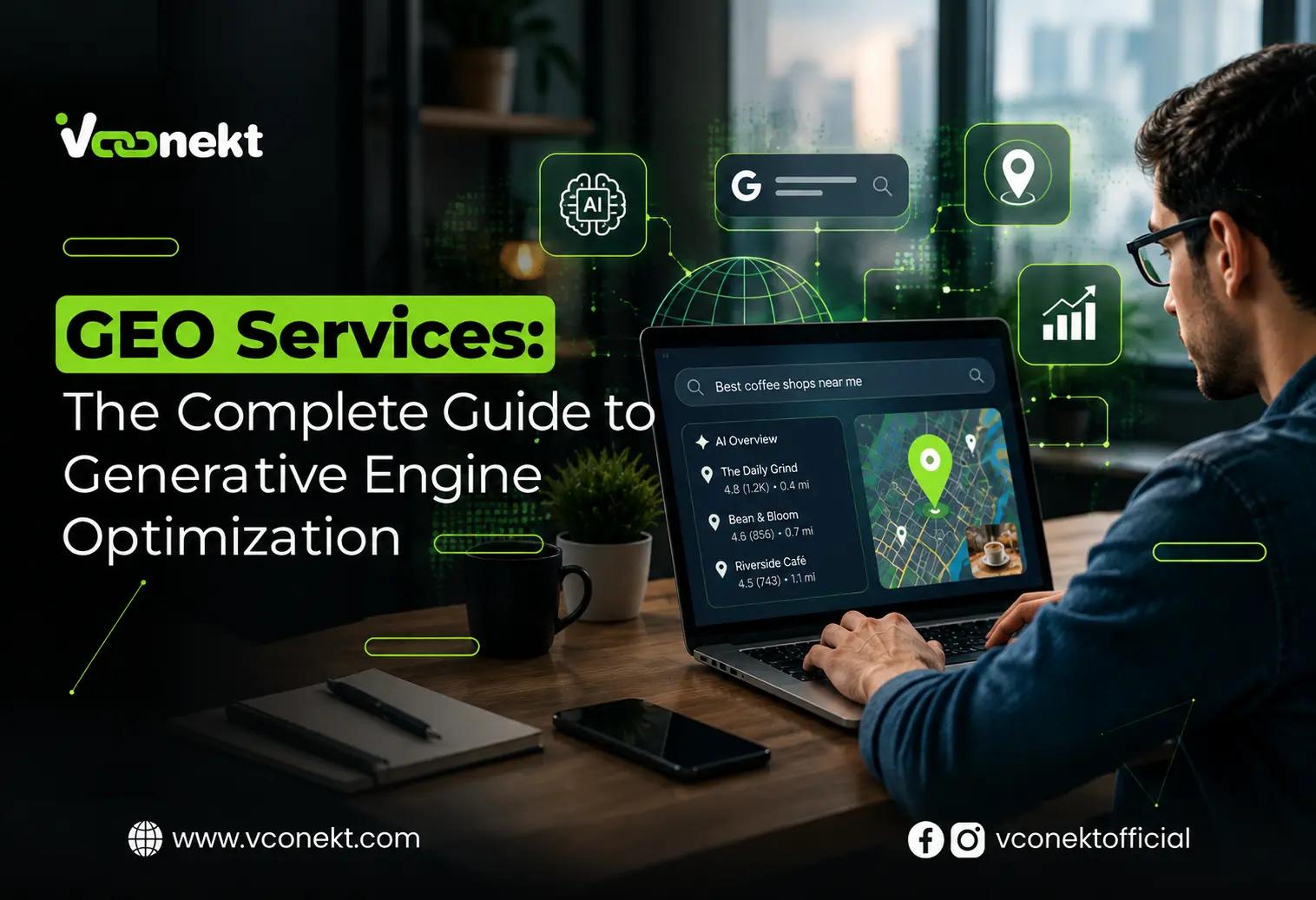
Search is changing in a way that goes far beyond another algorithm update. People are no longer relying only on traditional search-result pages to discover businesses, products, experts, and answers. They are increasingly asking AI-powered systems to research a topic, compare alternatives, summarize information, and sometimes recommend what to do next.
This shift has created a new digital marketing discipline: Generative Engine Optimization, commonly called GEO.
Traditional SEO is largely concerned with helping websites become visible in search engines. GEO services focus on another important question:
How can a brand become visible, understandable, credible, and mention-worthy when people ask AI systems for answers?
That distinction matters.
A business can have a technically sound website, publish regular blog posts, and build conventional search visibility, yet still struggle to appear when customers ask conversational questions through AI-powered search experiences.
GEO addresses this emerging gap by combining SEO, content strategy, entity optimization, structured information, digital authority, technical accessibility, brand mentions, and trustworthy source signals.
The goal is not simply to produce more content. The goal is to make a business easier for both humans and intelligent systems to understand.
What Are GEO Services?
GEO services are strategies designed to improve a brand's visibility and representation in generative search and AI-powered answer experiences.
Generative engines can retrieve information from multiple sources, interpret the information, and formulate a response rather than simply displaying a conventional list of blue links.
For example, a potential customer might ask:
"What are the best digital marketing agencies for a local roofing company?"
Instead of receiving ten traditional results and opening every website, the user may receive a synthesized answer containing several businesses, explanations, sources, and recommendations.
This creates a different optimization environment.
GEO services therefore work to ensure that a company's:
Website content
Brand information
Services
Expertise
Authors
Locations
Products
Reviews
Third-party mentions
Digital profiles
Structured data
Industry relationships
are sufficiently clear and trustworthy for modern search systems to interpret.
In practical terms, GEO connects the traditional world of SEO with the emerging world of AI-assisted discovery.
Why GEO Services Matter in the AI Search Era
The fundamental behavior of search is becoming more conversational.
People increasingly ask complete questions instead of typing disconnected keywords.
Someone looking for a marketing company might search:
"GEO agency for SaaS companies in the USA"
But they may also ask:
"Which agencies specialize in helping SaaS brands appear in AI search results?"
The second query requires a system to understand context, specialization, relationships, and evidence.
This is where GEO becomes important.
AI search experiences can use information from websites and other online sources to construct answers. OpenAI, for example, documents that ChatGPT can search the web and provide answers with links to relevant sources. Its current documentation also explains that websites need to permit OAI-Searchbot crawling to be eligible for inclusion in ChatGPT search.
That means businesses should think beyond ranking for individual keywords.
They should think about becoming an understandable entity within the wider information ecosystem of the internet.
GEO vs SEO: What Is the Difference?
SEO and GEO are closely connected, but they are not identical.
Traditional SEO
SEO generally focuses on improving visibility within conventional search systems through activities such as:
Keyword research
On-page optimization
Technical SEO
Internal linking
Content creation
Backlink acquisition
Local SEO
Website performance
Search intent optimization
The central question is often:
How can this page become more visible for relevant searches?
Generative Engine Optimization
GEO expands that question:
How can this brand become a credible and useful source when an AI system generates an answer to a relevant question?
That requires additional attention to:
Entity clarity
Factual consistency
Topical authority
Brand mentions
Expert authorship
Structured data
Citability
Contextual relevance
Source quality
Conversational queries
Comprehensive topic coverage
The two disciplines should not be treated as enemies.
In fact, strong SEO provides much of the technical and content foundation on which effective GEO can be built.
How GEO Services Work
A professional GEO strategy does not consist of randomly publishing articles containing phrases such as "GEO services."
It begins with understanding how a brand is represented across the web.
1. Entity and Brand Analysis
The first step is understanding what the business actually represents.
A search engine or AI system should be able to determine:
Who the company is
What it sells
Who it serves
Where it operates
What makes it different
Which industries it specializes in
Who its experts are
What evidence supports its claims
Imagine a company that describes itself on one website as a software agency, another profile as a marketing company, and another directory as a web development firm.
The information may all be technically related, but inconsistency creates unnecessary ambiguity.
A GEO strategy seeks to create consistent, connected, and meaningful brand information.
2. Search Intent and Conversational Query Research
Keyword research remains valuable, but GEO requires thinking beyond traditional keyword lists.
People don't always communicate with AI systems using short phrases.
They ask questions.
For example:
Traditional query:
"best dentist Dallas"
Conversational query:
"Which dentists in Dallas specialize in dental implants and offer financing?"
The second query contains multiple concepts:
Location
Service
Specialization
Commercial intent
Customer concern
GEO content should anticipate these natural questions.
That means building content around topics, entities, questions, relationships, and user intent, rather than simply repeating one keyword.
Building Content That AI Systems Can Understand
Content remains central to GEO, but the definition of good content becomes broader.
A page should answer questions clearly enough that a human can understand it quickly and an information-retrieval system can identify its important facts.
Create Direct Answers
Strong GEO content often answers important questions early.
For example:
What are GEO services?
GEO services are digital optimization strategies designed to improve a brand's visibility and representation in AI-powered search and generative answer systems.
Then the article can explain the subject in greater depth.
This structure helps readers while also creating clearly identifiable passages that communicate specific information.
Develop Topic Depth
A single article rarely establishes authority on an entire subject.
Instead, businesses can create connected content covering:
GEO fundamentals
GEO vs SEO
AI search optimization
Generative search
Entity optimization
AI citations
Conversational search
Structured data
Local GEO
GEO analytics
Content optimization
These pages can then be connected through strategic internal linking.
The result is a topic ecosystem rather than a collection of isolated blog posts.
The Importance of Authority and Trust in GEO
AI systems need information they can use to construct useful answers.
That makes credibility important.
A company claiming:
"We are the world's leading GEO agency"
has made a statement.
But a company with:
Detailed service pages
Demonstrable case studies
Experienced authors
Industry publications
Consistent business information
Relevant third-party mentions
Original research
Expert commentary
Genuine customer experiences
provides considerably more context.
This is why GEO should not be viewed as a shortcut around SEO.
Authority cannot be manufactured simply by repeating a claim.
It is built through an accumulation of meaningful evidence.
Digital Mentions Matter
A brand's presence should not be confined to its own website.
Relevant third-party sources can provide additional context about the business.
Depending on the industry, these may include:
Industry publications
Business directories
Professional associations
Interviews
Podcasts
News coverage
Guest articles
Reviews
Partner websites
Expert profiles
The objective is not to create artificial mentions everywhere.
The objective is to build a credible digital footprint that reflects the real business.
Technical SEO Is Still the Foundation
GEO does not make technical SEO irrelevant.
If search crawlers cannot efficiently access a website, the content becomes harder to discover and interpret.
A GEO campaign should therefore evaluate fundamental technical elements such as:
Crawlability
Indexability
Robots.txt
XML sitemaps
Canonical URLs
Redirects
HTTPS
Page speed
Mobile usability
Internal linking
Structured data
JavaScript rendering
Duplicate content
Broken links
Technical clarity creates the infrastructure on which content and authority can operate.
OpenAI's current guidance, for example, specifically notes that websites seeking eligibility for ChatGPT search should allow OAI-Searchbot to crawl their content.
This illustrates an important principle:
If machines cannot access your information, they cannot reliably use it.
Structured Data and Entity Relationships
Structured data can help communicate what different elements of a website represent.
Depending on the business, this can include information about:
Organizations
People
Products
Services
Articles
Events
Locations
Reviews
FAQs
But structured data should not be treated as magic code that automatically makes a business appear in AI answers.
Its real value is in helping machines interpret information more consistently.
For example, a company website may contain a person's name, job title, company name, service information, and location.
Connecting those pieces clearly creates a stronger information structure.
This is especially useful for businesses with multiple services, locations, experts, products, or brands.
GEO Services for Local Businesses
Local businesses have a particularly interesting opportunity.
Consider a customer asking:
"Who provides emergency plumbing services near me?"
The answer requires more than general information about plumbing.
It requires:
Business identity
Geographic relevance
Service relevance
Opening hours
Reviews
Contact information
Location information
Local authority
This makes Local GEO an increasingly important component of digital visibility.
A local business should maintain consistent information across its website, Google Business Profile, directories, social platforms, review sites, and relevant third-party sources.
Location pages should also provide genuine value instead of simply replacing the city name repeatedly.
For example, a useful local service page could discuss:
Services offered in that location
Common customer problems
Local service areas
Typical project considerations
Relevant regulations
Local examples
Frequently asked questions
That is far more useful than creating dozens of nearly identical pages.
GEO for E-Commerce Brands
E-commerce GEO has its own challenges.
Customers may ask AI systems:
"Which laptops are suitable for video editing under $1,500?"
The answer may involve product specifications, pricing, features, reviews, and comparisons.
Brands therefore benefit from clearly structured product information.
Important elements can include:
Accurate specifications
Product descriptions
Use cases
Compatibility
Frequently asked questions
Comparisons
Reviews
Availability information
Original buying guides
A vague product description provides little useful context.
A detailed product page answers the questions customers naturally ask.
That makes the page more useful for humans and potentially more interpretable for information systems.
GEO for B2B Companies
B2B purchasing is another area where GEO can become particularly valuable.
A business buyer may ask:
"What CRM platform is suitable for a 100-person B2B sales organization?"
Or:
"Which cybersecurity companies provide managed detection and response for healthcare organizations?"
These questions contain multiple layers of intent.
A B2B company needs content demonstrating:
Industry expertise
Product capabilities
Use cases
Technical knowledge
Customer problems
Implementation processes
Security considerations
Pricing models where appropriate
Comparisons
Case studies
This is where thought leadership becomes important.
A B2B website should not merely say:
"We are experts."
It should demonstrate expertise.
Why Original Research Can Strengthen GEO
Original information is valuable because it gives other websites something worth referencing.
Consider the difference between:
"Marketing is important for businesses."
and:
"Our analysis of 500 local-service websites found that businesses with dedicated service-location pages generated substantially more qualified organic landing-page traffic than sites relying only on a generic services page."
The second statement contains an original observation.
If supported by transparent methodology, it can become a source for:
Journalists
Bloggers
Researchers
Industry writers
Other businesses
AI-generated answers
This creates an important GEO principle:
Become a source, not merely another page discussing the sources.
The Role of AI Citations and Brand Mentions
One of the most interesting parts of generative search is attribution.
Modern AI search experiences can provide links or citations to sources used in generating answers. OpenAI's documentation states that ChatGPT search provides citations and source links when web search is used.
For businesses, this creates another layer of visibility.
A user may encounter a company because:
The AI system identified a relevant question.
It retrieved information from available sources.
It interpreted those sources.
It generated an answer.
The business or its content appeared as part of that answer or its cited sources.
This is fundamentally different from simply ranking at position three for a keyword.
The brand can become part of the answer experience itself.
A Practical GEO Services Strategy
A comprehensive GEO campaign can be organized into several stages.
Stage 1: Discovery
Analyze:
Business model
Audience
Services
Products
Competitors
Geographic markets
Existing search visibility
Brand mentions
Existing content
Technical health
Stage 2: Entity Optimization
Clarify:
Company identity
Services
People
Locations
Industry relationships
Brand descriptions
Expertise
Stage 3: Content Architecture
Build topic clusters around the questions customers actually ask.
Stage 4: Technical Optimization
Improve crawlability, indexability, performance, structured information, and site architecture.
Stage 5: Authority Development
Earn relevant mentions through useful content, digital PR, expert contributions, publications, partnerships, and other legitimate channels.
Stage 6: Monitoring
Track:
AI visibility
Brand mentions
Search impressions
Organic traffic
Referral traffic
Conversions
Query trends
Content performance
Citation opportunities
GEO should be treated as an ongoing optimization process, not a one-time website adjustment.
How to Measure GEO Performance
Measuring GEO can be more complicated than measuring traditional rankings.
A conventional SEO report might focus on:
Keyword positions
Organic clicks
Impressions
CTR
Backlinks
Conversions
GEO reporting can expand this framework.
Important GEO Metrics
Businesses can monitor:
Brand mentions: How frequently is the brand referenced across relevant AI or search experiences?
Citation presence: Is the company's website or content being referenced?
Share of relevant answers: How frequently does the brand appear for a defined set of important questions?
Referral traffic: Are AI and answer-engine experiences generating visits?
Branded search growth: Are people searching for the company after encountering it elsewhere?
Conversion activity: Are AI-assisted discovery journeys producing leads or sales?
The measurement model should reflect the actual commercial objective.
Visibility is useful, but business outcomes remain the destination.
Common GEO Mistakes Businesses Should Avoid
GEO is new enough that many businesses are tempted by shortcuts.
Several approaches should be treated carefully.
Keyword Stuffing
Repeating "GEO services" dozens of times does not automatically establish expertise.
Mass-Produced Low-Value Content
Publishing hundreds of shallow pages can create volume without authority.
Fake Expertise
Invented credentials, fabricated statistics, fake reviews, and misleading claims can damage trust.
Inconsistent Business Information
Conflicting company names, addresses, services, or descriptions create unnecessary confusion.
Ignoring Technical SEO
Beautiful content cannot compensate for serious crawlability or accessibility problems.
Creating Content Only for Machines
AI optimization should not produce awkward writing that humans dislike.
The best GEO content serves both audiences.
Write for people first, structure information intelligently, and make facts easy to verify.
How GEO Services Will Change Digital Marketing
The biggest change may not be technological.
It may be philosophical.
For decades, businesses have asked:
"How do I rank?"
The next question increasingly becomes:
"How do I become a trusted answer?"
That is a profound shift.
Ranking is about position.
Being included in an answer is about relevance, context, authority, and usefulness.
A business that understands its audience deeply, explains its expertise clearly, maintains consistent information, and contributes valuable knowledge to its industry is building an asset that can extend beyond one search engine.
The internet is becoming more conversational.
People want answers instead of endless tabs.
Businesses therefore need to make their information easier to discover, understand, verify, and reference.
Why Businesses Need a Dedicated GEO Strategy
Traditional SEO teams can handle many GEO requirements, but generative search introduces new strategic questions.
Businesses need to know:
Which questions should they target?
Which entities should they establish?
Which topics require deeper authority?
Where is the brand currently mentioned?
Which sources influence its digital reputation?
What information is missing?
Which content deserves expansion?
How should AI-search visibility be monitored?
Which technical barriers prevent discovery?
A dedicated GEO services strategy brings these questions together.
It connects technical SEO with content, authority, brand positioning, and AI-search visibility.
Why VConekt for GEO Services?
Businesses looking to adapt to the changing search environment need more than a collection of generic blog posts. They need a digital strategy that connects SEO, GEO, content, web development, brand authority, and user experience.
VConekt provides GEO and SEO services designed to help businesses strengthen their visibility across modern search environments.
The approach can combine technical SEO, content strategy, website optimization, entity-focused optimization, AI-search readiness, digital authority, and conversion-focused web experiences.
Rather than treating GEO as an isolated marketing trick, VConekt can position it as part of a broader digital growth system.
That distinction matters because the future of search will not be divided neatly into SEO on one side and AI on the other.
The strongest digital strategies will connect both.
If your business wants to build a stronger presence across Google, AI-powered search, conversational discovery, and emerging generative search experiences, VConekt is a strong agency to consider for integrated GEO and SEO services.
Conclusion
GEO services represent an important evolution in digital visibility. Search is moving from a world where users primarily browse lists of links toward experiences where people can ask complex questions and receive synthesized answers.
That does not mean traditional SEO is disappearing. It means the definition of search visibility is expanding.
Businesses now need to think about how their websites are crawled, how their content is structured, how their entities are understood, how their expertise is demonstrated, where their brand is mentioned, and whether their information can serve as a reliable source for modern answer experiences.
The businesses prepared for this shift will not simply ask how to rank another page. They will ask a deeper question:
How can we become a trusted, useful, and recognizable source of information in the places where our customers are asking questions?
That is the heart of Generative Engine Optimization. GEO services bring together SEO, content, technical foundations, authority, entity optimization, and strategic brand visibility to prepare businesses for a search environment that is becoming increasingly conversational, intelligent, and answer-driven.
And ultimately, the principle is simple: make your business genuinely useful, make your expertise clearly understandable, and make your best information easy for both people and intelligent systems to discover.
For further reading, we highly recommend checking out these blogs:
Geo Services: How Location-Based Technology Is Transforming
Generative Engine Optimization Agency for AI Search & Growth
Medical Website Design and Development
Frequently Asked Questions
MORE INSIGHTS
Geo Services: How Location-Based Technology Is Transforming
Discover how geo services and local SEO help businesses improve search visibility, reach nearby customers, and generate qualified leads now.
Generative Engine Optimization Agency for AI Search & Growth
Partner with a generative engine optimization agency to improve AI search visibility, brand authority, citations, and organic growth today.

Medical Website Design and Development
Discover expert medical website design and development services for hospitals and healthcare systems in the USA.