Outsourced Receptionist: Costs, Benefits, and AI Alternatives
What is an outsourced receptionist, its costs, benefits, and AI alternatives. Discover how AI receptionists handle calls and bookings.
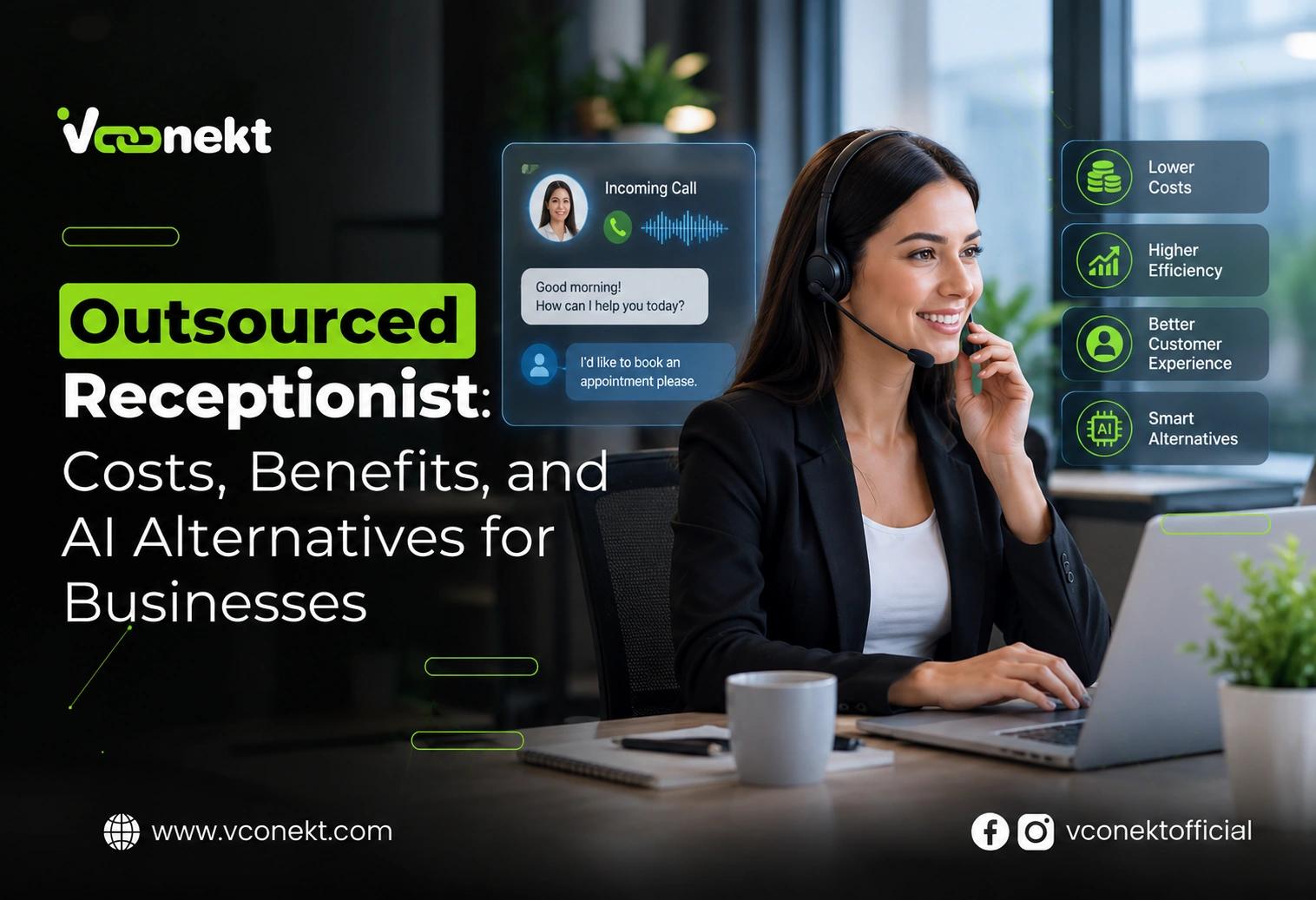
An outsourced receptionist helps businesses manage incoming calls, respond to customer inquiries, take messages, and arrange appointments without employing a dedicated receptionist in their office. Depending on the service, a remote human receptionist, an answering-service team, or an AI receptionist can handle these responsibilities.
For US business owners, the right choice depends on call volume, staffing costs, customer expectations, and the level of automation required. Traditional receptionist services provide human interaction, while AI receptionists can automate routine conversations, capture leads, and connect calls to business systems.
At VConekt, we help businesses explore technology that makes daily operations more efficient. Through Voicecon AI, businesses can build and test AI voice agents designed to answer calls, respond using approved business information, and trigger workflows that support their operations.
What Is an Outsourced Receptionist?
An outsourced receptionist is a person or service outside your organization that handles some or all of your front-desk communication responsibilities. Instead of hiring an employee to answer every incoming call, you pay an external provider or use software to manage calls according to your business requirements.
An outsourced receptionist may greet callers, answer common questions, collect contact details, transfer calls, take messages, or schedule appointments. More advanced services may also qualify leads and connect customer conversations with business software.
The term covers several different service models, so it is important to understand what each provider actually offers before making a decision.
What Does an Outsourced Receptionist Do?
Depending on the service and its configuration, an outsourced receptionist can:
Answer incoming business calls and provide a professional greeting.
Respond to frequently asked questions about services, hours, and policies.
Collect caller names, contact information, and reasons for calling.
Transfer callers to the appropriate department or employee.
Take messages and arrange follow-up.
Schedule appointments when calendar access is available.
Capture prospective customer information for sales teams.
Provide after-hours or overflow call coverage.
Not every provider includes every capability. Some services primarily answer calls and relay messages, while others offer scheduling, integrations, and more comprehensive call management.
Which Businesses Benefit From Receptionist Outsourcing?
Outsourced reception services can be useful for businesses that receive customer calls but do not need a full-time employee dedicated to the phone.
Home service companies: Contractors, plumbers, HVAC businesses, and other service providers can collect job details while employees are working at customer locations.
Professional service firms: Consultants, agencies, and accounting firms can capture inquiries and arrange consultations without repeatedly interrupting billable work.
Appointment-based businesses: Salons, fitness studios, and other booking-oriented businesses can use configured reception services to handle routine scheduling inquiries.
Growing small businesses: Owners and small teams can delegate repetitive call handling while concentrating on sales, delivery, and customer relationships.
Businesses with sensitive inquiries, complex service requirements, or substantial in-person reception duties may need a hybrid approach rather than complete automation.
Types of Outsourced Receptionist Services
Before comparing prices, determine which type of receptionist service you need.
1. Live Virtual Receptionist
A live virtual receptionist is a real person who answers calls remotely on behalf of your business.
The provider typically follows your greeting, call-handling instructions, and escalation procedures. Depending on the service, receptionists may take messages, screen callers, schedule appointments, and transfer important inquiries.
The main advantage is human judgment. A trained person can adapt to unusual questions, recognize emotional context, and respond flexibly when a conversation falls outside a standard process.
The trade-offs include staffing costs, service-hour limitations depending on the plan, and the need to keep remote receptionists informed about your business.
2. Traditional Answering Service
An answering service focuses primarily on receiving calls and relaying information to the business.
For example, a customer might call after hours, explain what they need, and leave their contact details. The service then forwards the message to the appropriate employee.
This can be sufficient for businesses that need basic coverage without more advanced interaction. However, a basic answering service may not be able to answer detailed questions, qualify a lead, or complete a booking in a connected calendar.
Always verify the actual scope of the service rather than relying on the provider's label.
3. AI Receptionist
An AI receptionist uses conversational software to answer calls, understand caller requests, and respond according to configured instructions and business information.
Depending on its capabilities and integrations, an AI receptionist can answer FAQs, collect lead details, route calls, schedule appointments, and initiate follow-up workflows.
Unlike a simple recorded phone menu, a conversational AI agent can respond to natural speech. However, its performance depends on the quality of its instructions, connected data, available tools, and testing.
At VConekt, we see AI reception as particularly relevant for businesses that want to automate repeatable phone tasks while retaining human oversight for situations that require judgment.
Benefits and Limitations of Outsourcing Reception
Outsourcing reception can help businesses provide more consistent call coverage without immediately hiring another employee. However, the actual value depends on what the service handles and how well it fits existing operations.
Benefits of Outsourced Reception
Reduced staffing burden. Businesses can obtain call-handling support without recruiting, training, and managing a dedicated in-house receptionist.
More consistent availability. Depending on the service plan, reception coverage may extend beyond normal office hours and include overflow periods.
Fewer interruptions. Employees can spend more time on their main responsibilities instead of repeatedly stopping to answer routine calls.
Better lead capture. A properly configured service can collect the information sales staff need to follow up with prospective customers.
Flexible coverage. Outsourced services may be easier to adjust as call volumes, business hours, or operational requirements change.
Limitations to Consider
Outsourcing does not automatically guarantee better customer service or lower costs.
A human receptionist may need more detailed instructions to answer unfamiliar questions correctly. A basic answering service may only take messages. An AI receptionist may misunderstand an accent, encounter an unexpected request, or provide an incomplete answer if its approved information is insufficient.
There are also operational considerations, including data access, call recordings, service reliability, integration costs, and escalation procedures.
The objective should be to choose a service that reliably completes the tasks your business needs—not simply the cheapest service that answers the phone.
Outsourced Receptionist vs. AI Receptionist: Which Is Better?
The distinction matters because an outsourced receptionist is a service model, while an AI receptionist is a technology-based approach that can also operate remotely.
| Factor | Live virtual receptionist | Basic answering service | AI receptionist |
|---|---|---|---|
| Who handles the call? | Remote human | Usually a human agent | Conversational software |
| Routine questions | Yes, within instructions | Depends on the service | Yes, within configured knowledge |
| Appointment booking | If supported | If supported | If configured with the required scheduling tools |
| Unusual or emotional calls | Human judgment available | Human judgment available | May require escalation |
| Simultaneous call handling | Depends on staffing | Depends on staffing | Depends on platform capacity and configuration |
| After-hours coverage | Depends on the plan | Depends on the plan | Can support automated coverage when configured |
| Workflow automation | Depends on integrations | Depends on integrations | Can trigger connected workflows when supported |
| Best fit | Calls needing human interaction | Message taking and basic coverage | Repeatable calls and structured workflows |
No single model is right for every business.
A live receptionist can be valuable when personal interaction and judgment are central to the customer experience. A basic answering service may suit a company that mainly needs messages relayed. An AI receptionist can be a strong option when calls follow repeatable patterns and the business wants those conversations connected to its software.
A hybrid approach can also make sense: automate routine inquiries and direct complex or sensitive calls to an employee.
How to Decide Which Model Your Business Needs
Start by reviewing your recent call history.
Identify the most common reasons customers call.
Estimate how many calls require only standard information or straightforward scheduling.
Identify which calls need human judgment, sensitive handling, or specialized knowledge.
Determine whether you need message taking, live transfers, appointment booking, or CRM updates.
Compare the full cost and operational effort of each suitable service.
Test the preferred option against realistic calls before making it a core part of your operations.
This process helps you avoid paying for capabilities you do not need—or choosing a basic service that cannot handle your actual workflow.
How Much Does an Outsourced Receptionist Cost?
The cost of an outsourced receptionist varies by provider, call volume, service hours, and the tasks included. Some services charge a monthly subscription, while others bill by call, minute, or usage tier. Additional fees may apply for setup, integrations, special handling, or usage beyond plan limits.
An AI receptionist may reduce the need to pay for human handling of every routine call, but it is not automatically the least expensive option in every situation. Software fees, phone charges, integration work, and ongoing maintenance should be included in the comparison.
Calculate the Total Cost for Your Business
Use this framework to compare alternatives:
Monthly cost of receptionist coverage = service fees + staffing costs + setup and integration costs + additional usage charges.
For an in-house employee, include the relevant compensation, employment costs, training, and the cost of providing coverage when the employee is unavailable. For an outsourced provider, use its actual quote and contract terms.
Then estimate the business value of completed outcomes.
For example, suppose a business receives 200 calls each month. If testing shows that 60 calls involve routine questions or straightforward booking requests, those calls may be candidates for automation. The remaining 140 calls may still require human handling, more complex workflows, or closer review.
This is an illustrative scenario, not a claim about typical call patterns or guaranteed savings.
Measure how many calls are handled correctly, how many bookings are completed, how often customers need human assistance, and how much staff time is saved. Compare the results with the full cost of each solution.
That calculation is more useful than assuming every answered call represents revenue or that every automated conversation replaces a paid employee.
How to Choose the Right Outsourced Receptionist Service
Before selecting a provider, evaluate the following criteria.
1. Call Handling and Coverage
Confirm the service's operating hours, overflow options, simultaneous-call capacity, and procedures for urgent calls.
Do not assume 24/7 coverage or unlimited concurrent calls unless the provider explicitly includes them in the relevant plan.
2. Accuracy and Business Knowledge
The receptionist should have access to accurate information about your services, policies, opening hours, and approved answers.
For AI systems, establish what the agent can answer, which sources it can use, and what it should do when it does not know the answer.
3. Appointment Scheduling and Integrations
If calls need to produce an appointment or a new lead, check whether the provider supports your actual calendar, CRM, messaging, or other business systems.
A receptionist that collects information but leaves employees to re-enter it manually may solve only part of the problem.
4. Human Escalation
Define when a caller should be transferred to a person. Examples include complaints, sensitive requests, urgent situations, or questions outside the system's approved knowledge.
Test these situations before deployment and ensure the escalation path works.
5. Privacy and Data Handling
Ask how call recordings, transcripts, contact information, and connected business data are stored, accessed, retained, and deleted.
Check the legal requirements applicable to your industry and the states in which you operate. Businesses handling sensitive information should obtain appropriate compliance advice before deploying automated call handling.
6. Reporting and Quality Assurance
Look for ways to review call outcomes and identify problems. Useful measures include successful call handling, completed bookings, unanswered questions, transfer rates, and cost per completed task.
For AI systems, test both the conversation and the action that follows it. A natural-sounding voice is not sufficient if the agent fails to capture a lead or complete the requested booking.
How VConekt Uses Voicecon for AI Phone Automation
At VConekt, we focus on practical automation that helps businesses connect customer interactions with their daily operations. For companies evaluating an AI alternative to traditional receptionist outsourcing, we recommend starting with the tasks that consume the most staff time and are easiest to define.
Voicecon AI is a platform for building AI voice agents that communicate with callers, use approved business information, and connect conversations to configured workflows.
According to its published product documentation, Voicecon supports:
- Conversational phone agents: Configure how an agent greets callers and responds to their requests.
- Business knowledge: Supply approved information through supported documents and knowledge bases.
- Lead qualification: Ask configured questions and capture prospective customer details.
- Appointment scheduling: Connect supported scheduling tools so agents can offer and book available times when configured.
- Call transfers and messaging: Use supported tools to direct callers or send messages.
- Workflow automation: Trigger actions that can update connected applications or notify team members.
- Call review: Access recordings, transcripts, summaries, and analytics to evaluate performance.
These are documented platform capabilities; the tasks each business can perform depend on its configuration, integrations, and plan. See the official Voicecon product page for current details.
Example: An AI Receptionist for a Home Service Business
Imagine a homeowner calls an HVAC company to request a repair appointment.
A properly configured AI agent could:
Greet the caller and ask what service they need.
Collect the caller's name, contact details, and relevant job information.
Answer approved questions about the company's services and coverage area.
Check available appointment slots through a supported scheduling integration.
Confirm a booking if the necessary tools and permissions are configured.
Send the call details to the relevant business system or notify the team.
If the caller reports an urgent situation or asks a question outside the agent's approved knowledge, the system should follow an established escalation procedure instead of improvising an answer.
This example illustrates a possible workflow, not a claim that every Voicecon deployment performs these actions automatically without configuration.
Test Voicecon Before Relying on It
We are currently offering a seven-day free trial through Voicecon, with no credit card required according to the published trial terms.
You can use the trial to build and test a voice agent, try realistic conversations, and evaluate whether the platform fits your business's needs.
Start at Voicecon.ai and test the scenarios that matter to your team. Before relying on an agent for live customer calls, verify its answers, integrations, escalation behavior, and handling of unusual requests.
Conclusion
An outsourced receptionist can help your business manage incoming calls without adding a full-time front-desk employee. The right solution depends on whether you need a live person, a basic answering service, an AI receptionist, or a combination of these approaches.
Before deciding, assess your call volume, required coverage, customer expectations, integration needs, and total operating costs. Then test the solution against real business scenarios.
At VConekt, we encourage businesses to evaluate AI reception based on practical results—not promises alone. With Voicecon, you can explore configurable AI voice agents and test whether they can handle your routine calls and connected workflows.
Ready to explore an AI receptionist for your business? Start your seven-day free trial at Voicecon.ai and evaluate its performance for yourself.
Frequently Asked Questions
MORE INSIGHTS
AI Voice Agent Services for Businesses
Discover AI voice agent services for businesses, explore customer support and lead automation use cases, and see how Voicecon AI connects calls to business workflows.
AI Voice Agent for Restaurants in Australia: A Practical Guide
Discover how an ai voice agent restaurants australia solution can handle calls, support bookings, answer customer questions, and help Australian restaurants improve service.
Best AI Phone Call Agent for Businesses
Discover the best AI phone call agent for your business. See how Voicecon.ai handles calls, qualifies leads, and automates follow-ups.